Wednesday, 14 December 2011

Guest post: Loving the Greens - Montessori and Dogme Part 2

0 comments
In part one Yitzha (Icha) Sarwono described how the central elements of Montessori define her teaching. In this part, she tells us about she became interested in Dogme ELT and how she has tried to implement it in her own class so far.


What first attracted me to Dogme teaching was the fact that it allows both teachers and students to explore more on what they really need instead of following a text book. I think Dogme is somewhat similar to Montessori in term of its focus which is on the students. I don't use any textbooks at all, just worksheets that are made based on what the students need to achieve so it varies between each student. We give them one and a half hour each day to explore what they want to work on while teaching them one on one. I will focus on their academic teaching while my assistants help them in exploring more on other aspects like practical life, culture etc. And then we'll have circle time where we will discuss about the topic and etc.

As a teacher I’ve always tried to find a way to make my class understand the lesson that I’m trying to get across, and for years I’ve tried to apply ways that I thought will make the learning process more fun as well as engaging for them. But of course aside from the lesson, I’ve always tried to build them up in couple of aspects that I could also achieve, like their confidence for example.

For the past 2 years I’ve been involved in teaching kindergarten Montessori classes. One of my main concerns is actually what they have during snack time. It is almost impossible to see them having vegetables in their lunch box! They seem to prefer having bread, rice and chicken nuggets, or jelly for their snacks. Of course our school has always provided either fruit or milk for them but still even though I’ve tried so many times to introduce greens to them.  I found out that many of them have actually never got a proper introduction to vegetables at home.

So, for quite some time I have been having lunch along with them, hoping for them to see what I have in my lunch box (and you can bet that I bring vegetables with me everyday!). Starting with introducing them and saying how delicious they are to my tongue to sharing some of my veggies to them. But of course it hasn’t always been easy as they mostly refuse to try my food.  So I thought that I’d try dedicating a whole week to get them to meet and get to know greens very well, as vegetables is one of the lesson we learn in school too.

And as I’ve been sort of introduced to Dogme teaching, and find it quite interesting to apply it on my Montessori class, I thought I would try to apply it to teaching about vegetables. So I set up my goals and planned my lesson and this is what I’ve done in classroom during presentation and circle time.


  1. Topics: As Vegetables are my topic of the week, I bought all the fresh vegetables that we are most likely to find and use to cook for our food at home, brought them to classroom and introduced them all to my students. I mentioned how good they are to our body. I laid them out one by one and explained them all. One thing is for sure though, some of my students kind of dislike the smell of the green stuff!

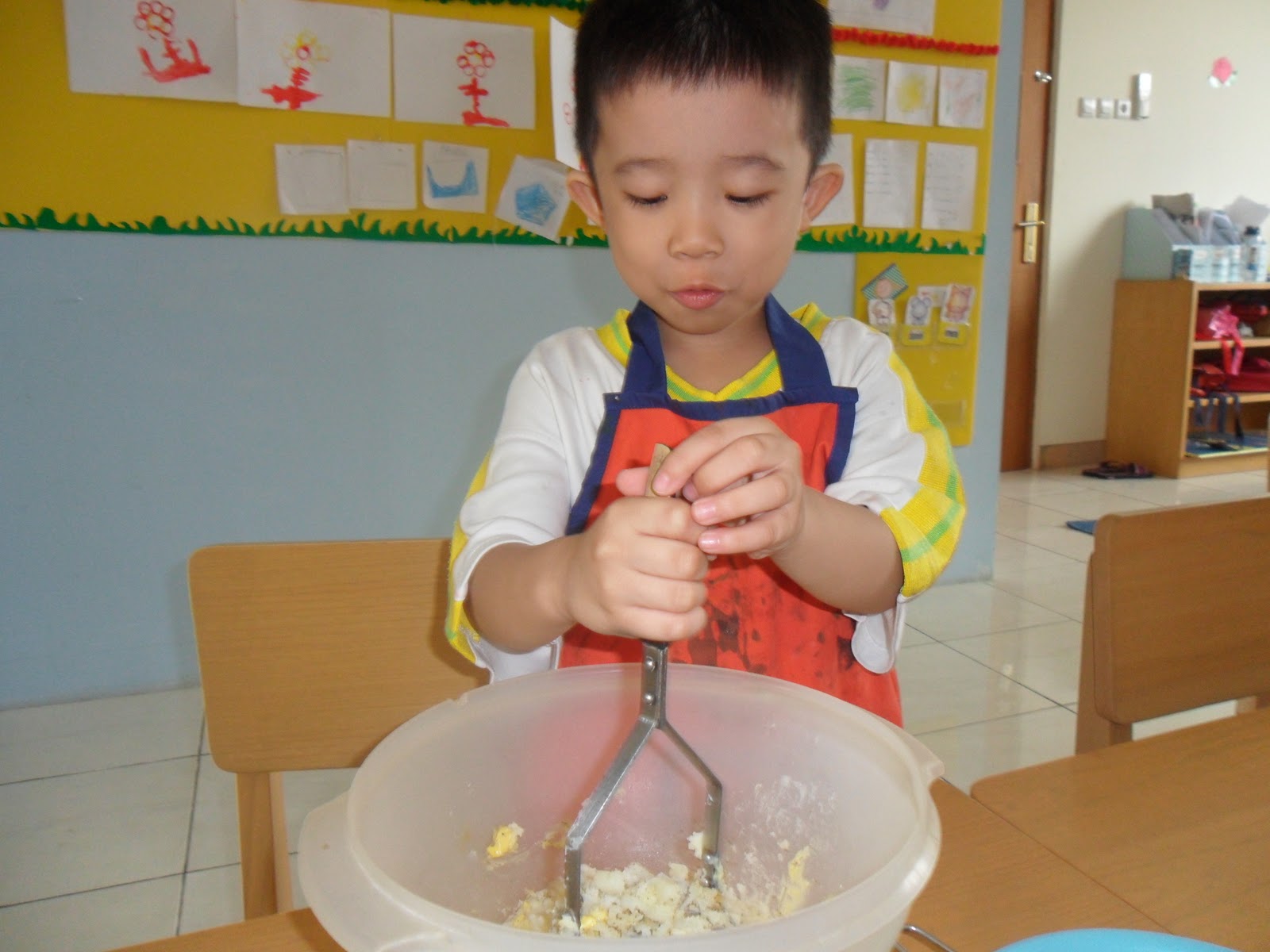
  2. Science: We put a handful of green beans into two bowls. In one bowl, I asked them to put dry cotton among the beans and in another, wet cotton and then put them by the window, to meet the sunlight. I told them that in few days, we’re gonna see the difference between two bowls. They were very surprised and happy of course to learn that the bowls with the wet cottons has produced great looking growing bean sprouts! While the other one stayed still as a collection of green beans.

  3. Outside: I took them to our outdoor playground and got them to play with the dirt! Literally! As I gave them hoe, shovel, spade and some seeds and let them dig the soil and plant what they want. It was a hit! And I got to work on their hand grip for motoric skills. In their culture lesson I could introduce them to different seeds and what would become of them should they grow nicely

  4. Construction art: As carrot is probably one of the most popular vegetable for them, we made paper maché carrots. It’s actually ended up as a 3 days project but my students loved it so much!

  5. Printing art: We made veggie printing pizza. I prepared cardboard in a round shape like a pizza, then prepared lots of vegetable and spices like french beans, onion, garlic, carrot, and mushroom. The children dipped the veggie and spices to their chosen paints and then print them on the cardboard pizza.

  6. Math: As we learnt about addition, I got them to do it by using the french beans. They loved it so much and when later I gave them some worksheet with pictures of vegetables on it, they were gladly doing it.

In tomorrow’s third part, Icha will give some more practical examples of how she has adapted Dogme for her classroom by creating teaching ‘booths’.
Read more ►

Tuesday, 13 December 2011

Guest post: Loving the Greens - Montessori and Dogme

0 comments
This is part one of three guest posts this week by Yitzha (Icha) Sarwono, a kindergarten Montessori school teacher in Jakarta, Indonesia. We were recently discussing Dogme during ELTchat, and as I have no experience Montessori teaching, I asked her to write about the possibilities for teaching unplugged in her particular situation. I started by asking her about the main elements of Montessori (as quoted on Wikipedia), and how they apply in her classroom:


Mixed age classrooms, with classrooms for children aged 2½ or 3 to 6 years old by far the most common

In the theory, it can be like that, but in Indonesia it is quite impossible since the parents are still demanding the grouping based on level and that is what is going on in my school, though they can be mixed too sometimes, usually when we are lacking in teachers!. Actually, my superior just came today and she told me that my class is ready to be mixed with others as they are very cooperative and has understood the concept of Montessori.

Student choice of activity from within a prescribed range of options

Yes, each day I give them around an hour an a half for them to choose the activity that they want to do, be it from math, language, culture, practical life or others. While some of them do that, I'll work on them one on one on the area where I need them to give more attention. SO for each student it can be different area. For example, my student Aliffa needs to work on her writing, while Keshia needs to work on her phonics and reading. I make notes on the area they have mastered and the one they need to build. And that is why Montessori works well in classes with different states of ability, since teachers still have time to focus on students. Of course it needs teachers who can really dedicate themselves to work on it and that is why many teachers (at least in my school) avoid being the Montessori teachers, for the responsibility is very high. But this is also the point where I think Montessori and Dogme teaching can run well together.

Uninterrupted blocks of work time

Yes, this is so true in the real Montessori classroom. When the child is tired and doesn’t want to continue on working on one thing/project, we'll take a break and let them continue the other day, so there is no time limit really. Most of the time, we got them to work on a project that will make them understand more on what they're learning. But of course the choices are theirs to make on which ones they want to do 1st.


A Constructivist or "discovery" model, where students learn concepts from working with materials, rather than by direct instruction

We come to class with either with real objects (like me bringing vegetables to class, for example), models/toys or if we couldn't find them (like now when I'm teaching about insects) we bring photos to the classroom, so they will never have to imagine what they look like, they can feel them, see them and explore them. When they learn about hundreds or thousands, they will hold a bunch of beans with the exact number, or when they learn about shapes, they will hold the material. So when the concept got into them, they will remember it well. In my experiences (because I have taught in classical based school before) this kind of materials do help them a lot, like before we build a word, I will show the material that we're going to spell, and then instead of writing it, we use what we call LMA (large moveable alphabet) that will be arranged based on the word we're building on. So, they will not only be in touch with the object but also with the forms of the letters we're using. Whenever I teach them some early grammars, this will also work better as they can experience them first hand.


Specialized educational materials developed by Montessori and her collaborators

Each school, even each class, develops their own lesson plan as they are the one who knows what their students need. We have guidelines on what is our goal for that week but of course all teachers will also work on what their students need. This is what I’ve mentioned before , about the worksheet. We don't really have real test for them as they are still kindergarten but as Montessori has no particular workbook to use too, what we -the teachers- will prepare is a worksheet according to what they're learning. For instance, for my student Aliffa I'll give them more writing exercises or projects, and for Keshia I'll ask her to spell words together with me and then have her write them down on what we call pink line paper, so she'll remember it. So each students have their own personalized and customized worksheet. Tough job for the teachers of course, but I suppose this is needed to make sure all are treated well and fair. Of course for some material like logic exercises or culture, we can have the same worksheet for all.

The second part of Icha’s post will look at practical examples of how she teaches, and how she thinks it overlaps with Dogme ELT.


Read more ►

Friday, 9 December 2011

What's the Time?

7 comments

It’s funny how something that seems like a fairly inconsequential idea at the time can end up becoming something that you integrate into your teaching and you can’t believe you didn’t think of it before. For example...


Being of an unplugged persuasion, I never pre-teach vocabulary. Rather, I let the students tell me which words, phrases, expression, chunks, sentences and so on they’d like to check. I’m not exactly sure why anyone thinks they are aware of exactly what language the student doesn’t know before they've even had a chance to check a text.


Anyway, here’s a phrase I’ve used countless time when showing a video to my students:

“Watch the video and make a note of any language that you’d like to check after.”

Seems pretty innocuous doesn’t it? However, built into that sentence is an inherent contradiction that is very unfair on the student. What if I put it like this?

“Watch the video and write down all the things you don’t understand.”

When I put it like that it seems pretty ridiculous, doesn’t it? Exactly how are the students supposed to write down things they don’t know? And if you’re showing a video or playing some audio, it’s easily avoided. Just make sure the students can seem the countdown as it plays, and ask them to make a note of the times they’d like to go back to in order to check on a doubt.


“It’s such a tiny, simple thing on the surface, but it really lets you do so much. Just as you can use a reader response code to unlock the student’s internal dialogue with a written text – and to pinpoint difficulties in understanding – so you can use a code with the numbers to access the student’s reactions to an audio text – and to go back and revisit the points of difficulty ...a small advantage (that) can yield tremendous results.”

Read more ►

Wednesday, 30 November 2011

Learner Diaries: Reading Woe & Writing Joy Part 2

1 comments
I wrote here about how I battled with a story given to me by my Portuguese teacher. If you haven’t read it, I suggest you read that first, or this post won’t make much sense.

Feedback, or Should I Say Correction?

So having expressed my displeasure at the difficulty of the story to my teacher, I was interested to see how he would react. I wasn’t too concerned about his response as while he may have flaws as a teacher, but he doesn’t seem to have too many as a human being, so I felt that he would deal with it in a positive way. Fortunately, I was correct in my assumption.

His first reaction was to reply to my email. He said he was grateful for the feedback which was very important to him (which begs the question “why doesn’t he ask for it then?!”) and that he was surprised, not just to receive an email from me, but by the length and by the quality of my writing, which I was pretty happy about as you can imagine.

Later before the lesson, he gave me a print out with my errors corrected, which I hadn't asked for but was more than happy to receive. We then discussed, as best I could within my linguistic limits, the content of my email, and how we both recognised how difficult it was to teach multi-level classes. He was completely open to my suggestions and actually seemed pretty pleased to have someone to talk about these things with. As I know, the freelance teacher’s life can be lonely... (but I have my PLN to save me!)


Outed

At the beginning of the class, he brought up the subject of my email and my suggestion. I didn’t mind this too much, but it was a little bit embarrassing. Firstly, even though most of the other students agreed that it was very difficult, I was the only student who hadn’t actually finished the story (of course, reading the story all the way through is one thing, but understanding it and then appreciating it are others). This did make me feel a bit like the least able student, which may be the truth but luckily being a teacher makes me able to deal with that fairly comfortably. However, it’s still not the most pleasant situation to be in.

In general the reaction to the idea could best be described as.... well, lukewarm. No one was offended by it, but they weren’t that thrilled by it either. I had to remember that this is a pretty unusual idea for most students, so I presume that what they see is a lot of unnecessary work when they could just be given a text by the teacher. That’s why the teacher has to really sell an idea like this to the students by being enthusiastic after having thoroughly thought the idea through. As this seemed to be a new idea for my teacher too, I don’t think he put enough into it to convince the other students.

The Long and Winding Speech

We then discussed my idea, or we at least tried to, until one of the chattier learners decided to take this opportunity to tell us all about her favourite website and why it’s so great. Unfortunately the teacher didn’t step in and curtail this particular diatribe which went on for far too long, and somewhat sidetracked the conversation. Being a teacher makes you acutely aware of how distracting these kinds of ‘speeches’ can be. Sometimes the students can be too student centred, unfortunately.

The teacher came back to the theme at the end of the lesson, and he came to a compromise. For homework, he asked us to go to that particular website (so I’ll find out just how wonderful it is for myself...), choose an article and write a paragraph explaining why we chose it. What we’ll do with those paragraphs, I’m not sure, but I’ll email mine to him in advance. It’s a pretty good activity, much better than before, and a huge step in the right direction.

Lessons Learned

So what have I learned from this experience? Quite a lot, I think...
  • Students shouldn’t be reticent about telling their teachers what they think, but also teachers should be bold enough to combine an acceptance of these ideas with a confidence in their own ability.
  • If the teacher doesn’t entirely believe in an activity, then either he/she has to work at understanding it more, or they should get rid of it completely.
  • Sometimes someone can have the potential to be a great teacher, but without the right guidance, training, mentoring and reflection, the students are only going to see glimpses of it.
  • The wrong text to the wrong student can have a catastrophic effect, one that really can’t be underestimated and I think often is.
  • Don’t let students prattle on. That’s not student centred, it’s quite the opposite because the other students are the ones who are suffering.
  • If you’re going to make changes to the class at a student’s behest, don’t ‘out’ them. Talk about it in general terms, and allow them to tell the class if they wish.
And for my own learning...
  • Speak to my teacher more about teaching. I think he’ll enjoy it, it’ll make my classes a bit better, and I’ll get to talk about my favourite subject in Portuguese.
  • Make suggestions slowly. I’m not going to overwhelm him with the last twenty years of language teaching approaches (I wish I could!), but I can hopefully make small incremental changes that will help everyone. First thing I’m going to do is ask him to give feedback on my writing by only underlining my mistakes and not correcting it for me.
  • Write more!

And finally, I hope you can see how much I get from studying a foreign language. Aside from actually acquiring an another language, I also get an immensely satisfying and fulfilling training course, which encourages self reflection and personal development. As a language teacher, I can’t understate how valuable I think it is.

Part one of Learner diaries: reading woe & writing joy

Learner diaries: Reading, stories & vocabulary.


It appears some people are having problems leaving comments. If that happens to you, please email your comment to theteacherjames@gmail.com and I'll post it for you. I'd hate to miss out on your feedback! Thanks.
Read more ►

Friday, 25 November 2011

Minimal Materials Blog Challenge: Vocabulary Revision with Post It Notes

3 comments
Richard Gresswell (@inglishteacher) has been running a minimal resources blog challenge over on his ELTbites blog. Here are his rules:

“Describe an activity that requires no more than the teacher, students, and possibly making use of the  board, pens, and paper. Describe the activity aims and procedure concisely in no more than 200 words.”

So here’s my entry, a simple vocabulary revision activity I did last week with a class of two business students...

In the previous lesson, one of the language needs that emerged was how to express an opinion. In the next class I wanted to revise the vocabulary that we had worked on.

  • I gave each student a pad of post it notes and asked them to write something that someone could have an opinion about, serious or light, on the sticky side up, without letting their partner see. I had written an example on each pad to help them (the book you’re reading, your boss).
I’m assuming post-it notes are allowed in the challenge. It seems pretty minimal to me, but I could have easily used torn up paper and shuffled them like playing cards.
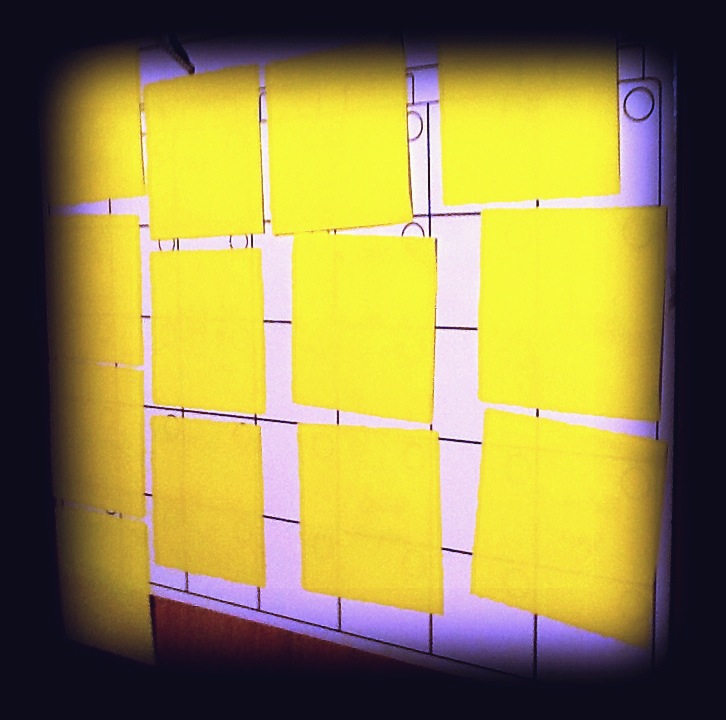
  • As they wrote each note, they gave it to me and I stuck it to a small whiteboard I have.

Post it notes stuck to the board.
  • After they had written 6 notes each, I asked them to choose a note from the board. Because they had written on the sticky side up, they couldn’t see what they were choosing.
  • They then asked their partner a question based on this subject.
This was a little twist that they weren’t expecting. I like to include these kinds of twists as it keeps them on their toes, and also revealed that they need some help in formulating these kinds of questions, something I’ll come back to in the next class.
  • They took turns in answering the partner’s questions, expressing their opinion each time with the new vocabulary.

To read more entries in the challenge, head over to Richard’s blog: 

It appears some people are having problems leaving comments. If that happens to you, please email your comment to theteacherjames@gmail.com and I'll post it for you. I'd hate to miss out on your feedback! Thanks.


Read more ►
 

Copyright © TheTeacherJames Design by O Pregador | Blogger Theme by Blogger Template de luxo | Powered by Blogger