Browse »
Home »
Posts filed under montessori
In the third and final part of Yitzha (Icha) Sarwono’s guest blog post, she will show us how she uses teaching booths as part of her unplugged Montessori teaching. You can read part one here and part two here.
Other than group presentation, I also provided booths for them to come and perform activities that have got something to do with vegetables. As I tried to apply Dogme teaching as well as staying in Montessori environment, I give them time to work on project that they like while in the mean time trying to stay on the theme of vegetables. And this is what I set up for them:
Vegetables muscle work: I prepared carrots, tomatoes, cucumber and long beans. They can choose between grating the carrot, slicing the cucumber, cutting the tomatoes or long beans. I did however pay very close attention when they were using the knife as I had to make sure they didn’t hurt themselves. They loved this booth so much that each one couldn’t wait for their friend to finish their turn.
Logic booth: Here I asked them to sort between red beans, soya beans, and green beans. They had to group the beans in a small bowl, then paste some of it on a worksheet that I have prepared for them based on the group. Though not all like the pasting part, they sure enjoyed the sorting time.
Grammar booth: As I was aiming for them to learn more about singular and plural, I laid down the vegetables in singular and plural form and then asked them to do the same. Though they still had difficulties with the vocabulary but since they knew the first letter of each word, they could match each vegetable with their writing.
Culture lesson: I asked them to place the fresh vegetables aside the picture of a cooking where they have to match them; carrot in a picture of soup, long beans in a picture of gado-gado (traditional Indonesian salad), potato in a picture of mashed potatoes and spinach in a picture of a sauté spinach.
Math: aside from addition I was also repeating the last lesson which is ‘less’ by asking them to put less vegetables in the provided mat next to their pair which was the same type of vegetables but with ‘more’ numbers than the one they had to complete.
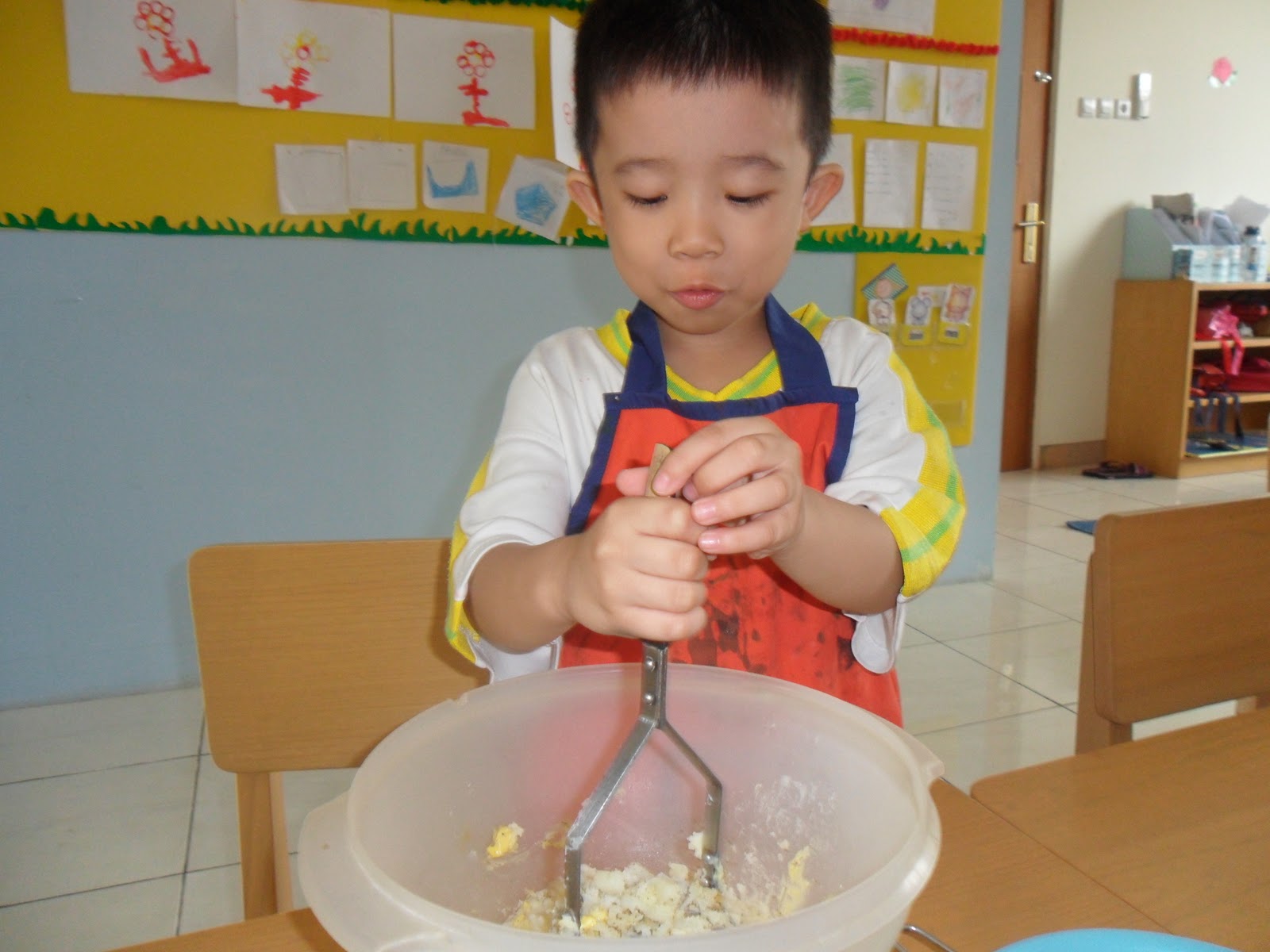
Cooking booth: as my goal was to get them to eat vegetables, I set up a cooking booth where we made mashed potatoes and baked broccoli with cheese. They helped me mashed the steamed potatoes and mix them with milk, cheese (lots of cheese! :D ), butter, spices like oregano, salt, and pepper and also a secret ingredient which was a mix of pureé broccoli and spinach! Thanks to the huge amount of cheese, the mashed potatoes were a hit! I did baked broccoli with cheese too, but of course as they could see the greens under the cheese, not too many of them would love to eat them all up, they usually just gulped down the cheese and left the curly broccoli alone.
Well, I can’t say that this has changed the way they see the greens, as they still consider them to be an alien, but during this lesson I do hope I can let them to at least learn to get to know them better.
Read more ►
In part one Yitzha (Icha) Sarwono described how the central elements of Montessori define her teaching. In this part, she tells us about she became interested in Dogme ELT and how she has tried to implement it in her own class so far.
What first attracted me to Dogme teaching was the fact that it allows both teachers and students to explore more on what they really need instead of following a text book. I think Dogme is somewhat similar to Montessori in term of its focus which is on the students. I don't use any textbooks at all, just worksheets that are made based on what the students need to achieve so it varies between each student. We give them one and a half hour each day to explore what they want to work on while teaching them one on one. I will focus on their academic teaching while my assistants help them in exploring more on other aspects like practical life, culture etc. And then we'll have circle time where we will discuss about the topic and etc.
As a teacher I’ve always tried to find a way to make my class understand the lesson that I’m trying to get across, and for years I’ve tried to apply ways that I thought will make the learning process more fun as well as engaging for them. But of course aside from the lesson, I’ve always tried to build them up in couple of aspects that I could also achieve, like their confidence for example.
For the past 2 years I’ve been involved in teaching kindergarten Montessori classes. One of my main concerns is actually what they have during snack time. It is almost impossible to see them having vegetables in their lunch box! They seem to prefer having bread, rice and chicken nuggets, or jelly for their snacks. Of course our school has always provided either fruit or milk for them but still even though I’ve tried so many times to introduce greens to them. I found out that many of them have actually never got a proper introduction to vegetables at home.
So, for quite some time I have been having lunch along with them, hoping for them to see what I have in my lunch box (and you can bet that I bring vegetables with me everyday!). Starting with introducing them and saying how delicious they are to my tongue to sharing some of my veggies to them. But of course it hasn’t always been easy as they mostly refuse to try my food. So I thought that I’d try dedicating a whole week to get them to meet and get to know greens very well, as vegetables is one of the lesson we learn in school too.
And as I’ve been sort of introduced to Dogme teaching, and find it quite interesting to apply it on my Montessori class, I thought I would try to apply it to teaching about vegetables. So I set up my goals and planned my lesson and this is what I’ve done in classroom during presentation and circle time.
Topics: As Vegetables are my topic of the week, I bought all the fresh vegetables that we are most likely to find and use to cook for our food at home, brought them to classroom and introduced them all to my students. I mentioned how good they are to our body. I laid them out one by one and explained them all. One thing is for sure though, some of my students kind of dislike the smell of the green stuff!
Science: We put a handful of green beans into two bowls. In one bowl, I asked them to put dry cotton among the beans and in another, wet cotton and then put them by the window, to meet the sunlight. I told them that in few days, we’re gonna see the difference between two bowls. They were very surprised and happy of course to learn that the bowls with the wet cottons has produced great looking growing bean sprouts! While the other one stayed still as a collection of green beans.
Outside: I took them to our outdoor playground and got them to play with the dirt! Literally! As I gave them hoe, shovel, spade and some seeds and let them dig the soil and plant what they want. It was a hit! And I got to work on their hand grip for motoric skills. In their culture lesson I could introduce them to different seeds and what would become of them should they grow nicely
Construction art: As carrot is probably one of the most popular vegetable for them, we made paper maché carrots. It’s actually ended up as a 3 days project but my students loved it so much!
Printing art: We made veggie printing pizza. I prepared cardboard in a round shape like a pizza, then prepared lots of vegetable and spices like french beans, onion, garlic, carrot, and mushroom. The children dipped the veggie and spices to their chosen paints and then print them on the cardboard pizza.
Math: As we learnt about addition, I got them to do it by using the french beans. They loved it so much and when later I gave them some worksheet with pictures of vegetables on it, they were gladly doing it.
In tomorrow’s third part, Icha will give some more practical examples of how she has adapted Dogme for her classroom by creating teaching ‘booths’.
Read more ►
This is part one of three guest posts this week by Yitzha (Icha) Sarwono, a kindergarten Montessori school teacher in Jakarta, Indonesia. We were recently discussing Dogme during ELTchat, and as I have no experience Montessori teaching, I asked her to write about the possibilities for teaching unplugged in her particular situation. I started by asking her about the main elements of Montessori (as quoted on Wikipedia), and how they apply in her classroom:
Mixed age classrooms, with classrooms for children aged 2½ or 3 to 6 years old by far the most common
In the theory, it can be like that, but in Indonesia it is quite impossible since the parents are still demanding the grouping based on level and that is what is going on in my school, though they can be mixed too sometimes, usually when we are lacking in teachers!. Actually, my superior just came today and she told me that my class is ready to be mixed with others as they are very cooperative and has understood the concept of Montessori.
Student choice of activity from within a prescribed range of options
Yes, each day I give them around an hour an a half for them to choose the activity that they want to do, be it from math, language, culture, practical life or others. While some of them do that, I'll work on them one on one on the area where I need them to give more attention. SO for each student it can be different area. For example, my student Aliffa needs to work on her writing, while Keshia needs to work on her phonics and reading. I make notes on the area they have mastered and the one they need to build. And that is why Montessori works well in classes with different states of ability, since teachers still have time to focus on students. Of course it needs teachers who can really dedicate themselves to work on it and that is why many teachers (at least in my school) avoid being the Montessori teachers, for the responsibility is very high. But this is also the point where I think Montessori and Dogme teaching can run well together.
Uninterrupted blocks of work time
Yes, this is so true in the real Montessori classroom. When the child is tired and doesn’t want to continue on working on one thing/project, we'll take a break and let them continue the other day, so there is no time limit really. Most of the time, we got them to work on a project that will make them understand more on what they're learning. But of course the choices are theirs to make on which ones they want to do 1st.
A Constructivist or "discovery" model, where students learn concepts from working with materials, rather than by direct instruction
We come to class with either with real objects (like me bringing vegetables to class, for example), models/toys or if we couldn't find them (like now when I'm teaching about insects) we bring photos to the classroom, so they will never have to imagine what they look like, they can feel them, see them and explore them. When they learn about hundreds or thousands, they will hold a bunch of beans with the exact number, or when they learn about shapes, they will hold the material. So when the concept got into them, they will remember it well. In my experiences (because I have taught in classical based school before) this kind of materials do help them a lot, like before we build a word, I will show the material that we're going to spell, and then instead of writing it, we use what we call LMA (large moveable alphabet) that will be arranged based on the word we're building on. So, they will not only be in touch with the object but also with the forms of the letters we're using. Whenever I teach them some early grammars, this will also work better as they can experience them first hand.
Specialized educational materials developed by Montessori and her collaborators
Each school, even each class, develops their own lesson plan as they are the one who knows what their students need. We have guidelines on what is our goal for that week but of course all teachers will also work on what their students need. This is what I’ve mentioned before , about the worksheet. We don't really have real test for them as they are still kindergarten but as Montessori has no particular workbook to use too, what we -the teachers- will prepare is a worksheet according to what they're learning. For instance, for my student Aliffa I'll give them more writing exercises or projects, and for Keshia I'll ask her to spell words together with me and then have her write them down on what we call pink line paper, so she'll remember it. So each students have their own personalized and customized worksheet. Tough job for the teachers of course, but I suppose this is needed to make sure all are treated well and fair. Of course for some material like logic exercises or culture, we can have the same worksheet for all.

The second part of Icha’s post will look at practical examples of how she teaches, and how she thinks it overlaps with Dogme ELT.