Friday, 11 May 2012

Just Say Yes

31 comments
About a year ago, I made a decision. It was the kind of decision that people have made careers out of, especially the writer Danny Wallace who coincidentally was at my university at the same time as me. Since he studied Journalism and became a writer and I studied Media, specifically television, and became a teacher of English as a foreign language, I’m going to assume that his days at the University of Westminster were rather more productive than mine.

He went to write a book called Yes Man, which was Hollywoodified (that's my word but you can use it...) into a movie staring Jim Carrey, who I definitely did not go to university with. Anyway, back to me. My decision, which was in no way at all influenced by either the book or the film (I regret mentioning them now, to be honest) was to say yes. To everything. Within reason.

Taken from http://bit.ly/JvESrw

I'm talking professionally here. You see, I don't believe in luck. I'm a rationalist, I believe that science is our ticket to a golden future and that our destiny lies in our own hands. Sure, sometimes circumstance and coincidence can wreck our plans, but it's not luck, because it doesn't exist.

If you've read this blog in the past or know me personally, you know that I became an EFL teacher because I moved to Brazil and didn't really have any other alternative job options. So I guess you would think that I was lucky because I only had one option and I loved it? I politely disagree. It's a coincidence that the one job I could do is also one I love. And how did this coincidence come about? Because I moved from London to Brasilia. I made the coincidence possible because I took a risk and went for it.

Once I realised how this sequence of events had occurred, it changed how I see the world and I made my decision to say yes to everything that I reasonably could (you have to know your limitations). And what has happened since then? Let me give you an example...

At the IATEFL conference in March, ELTchat hosted a symposium. I, me, James Taylor, theteacherjames, was featured in the first three talks. I don't tell you this to show off, really, but because it illustrates my point. Marisa Constantinides mentioned me because I am the producer and presenter of the ELTchat podcast, something I volunteered for after seeing a request on Twitter, despite having never made a podcast before. With my media background, I was confident I could learn what was required of me in order to put a podcast together, so I said yes and it's been great fun so far.

In the second talk, Shaun Wilden showed a video that I made for him on his subject hashtagging. I don't consider myself to be particularly knowledgeable on the topic, but I racked my brains and come up with something I hoped would be useful. Why? Because he needed a hand and why not? It took 5 minutes of my time and was helpful to him.

Finally, Sharon Hartle used my summary of an ELTchat from last year as an example in her talk. Coincidentally (not luckily!), this was Sharon's first ever ELTchat and included her first ever tweet. My summary was used because I volunteered to do it after what had been a feisty and fascinating chat. This was my first ever ELTchat summary, and I volunteered because it was a subject I'm passionate about and I wanted to contribute to the community that was giving me a lot. Somebody asked, and I said yes.

I could go into more details, but what it comes down to is that as well as the above, I have been to conferences in Switzerland and France, my writing has been featured in an ELT journal for the first time, I have reviewed books, I have spoken to Petra Pointner and her class via Skype, I've met two great Belgian teachers, I've given my first presentation, I’ve been featured on blogs, and more. All through saying yes.

Am I richer as a result? Well that depends on how you define richer. In monetary terms, no, categorically no (those conferences are expensive!). However, I prefer to look at it in non-monetary terms. I've met great people, been involved with fun projects, improved my skills and I hope become a better person. In that sense, I'm the richest man in ELT.

So can you do the same? Of course you can! To kick you off, I'm going to ask you some questions and you can begin by saying yes to a few...
1) Will you start blogging about teaching? 
2) Will you get involved in ELTchat whenever you can? 
3) When someone asks for help on Twitter or Facebook, will you help them? 
4) Will you help your colleagues, even though they might not help you back? 
5) Will you start using Twitter and Facebook for your professional development? 
6) If someone asks you specifically to help them, will you say yes even if it means stepping out of your comfort zone? 
7) Will you start to read more ELT blogs? 
8) Will you tackle that pile of methodology books you've been meaning to read? 

9) Will you ask for help from your PLN and not feel discouraged if you don’t get the result you were hoping for?
 
10) Will you start to say yes more often?
That should get you going! Be sure to let me know how it goes.


Update:

Some people have posted relevant links in the comments which I thought I’d share with you here above the line:


Cecilia Lemos shared the fascinating story of Profeta Gentileza (Prophet Kindness), who has painted the phrase “Kindness generates kindness” around Rio de Janeiro in Brazil.

Adam Simpson shared the following TED talk on the power of yes:


Phil Pethybridge was “peeved” by this post and responded here, including my reply.


And here's a quote I saw on the Facebook page of the School of Life that seemed relevant:


Read more ►

Monday, 12 March 2012

Learner Diaries: Getting to Know You

19 comments
Last week one of the students in my Portuguese class invited everyone around for dinner and not just any dinner, but my favourite Brazilian dish, moqueca de peixe. Unfortunately, I don't have a great rapport with the other students in my class. This is because they are all a little more advanced than me and we don't really talk to each other in class as most of our conversations are through the filter of our teacher. However, they seem like nice people and I can never resist that particular recipe. Furthermore, it was a very generous invitation and it would have been churlish of me not to go without a good reason, so I went.
Fish and shrimp moqueca - Day66
Moqueca de piexe, courtesy of Carla Arena (@carlaarena).
Over the course of the evening, we chatted, as you would expect, and I found that, unbeknownst to me, Maria* teaches conversational French, that Sara spent a great month in Manaus in Brazil but didn't like Rio at all, that Bob had a lovely Christmas in London with his girlfriend, and our host Michelle paints, specialising in pictures of Brazilian life.


The thing is that we have been in the same class now for nearly a year, and it's taken me that long to find out these things. Putting my teacher hat back on, I can't help but wonder how the classes might have been different if we had gotten to know each other better.


In Zoltan Dornyei and Kata Czizer's Ten Commandments for Motivating Language Learners, they state that the following "micro-strategies" are requirements that teachers need to enact in the classroom in order to motivate their students:

       1. Set a personal example with your own behaviour.
       2. Create a pleasant, relaxed atmosphere in the classroom.
       3. Present the task properly.
       4. Develop a good relationship with the learners.
       5. Increase the learners' linguistic self-confidence.
       6. Make the language classes interesting.
       7. Promote learner autonomy.
       8. Personalize the learning process.
       9. Increase the learners' goal-orientedness.
       10. Familiarize learners with the target culture.
Personally, since I first read this list and its accompanying article just after I finished my CELTA, I have found that this has provided me with a fundamental guide for how to set up my classroom. My every act and utterance need to be directed in such a way as to make the learners as motivated as possible, and subsequently I hope my students will have the desire to succeed, however they define it.


Looking at numbers two, four, five, seven and eight on Czizer and Dornyei's list, it seems to me that creating a rapport between students is either fundamental or mighty useful in each case. This sense of rapport enables the students to become more involved in the class as an entity, irrespective of the subject being studied, but with the benefit that their involvement in the class increases and subsequently so does their knowledge of the language.


When you teach adults in EFL as I do, you must not underestimate the social nature of what it is that we do. Language lessons are not the most academic in the world and they are often undertaken as a social activity by people who have two hours of lessons a week and don't always have time to do their homework.** Don't misunderstand me, there's nothing wrong with that and there's nothing to apologise for. I'm not suggesting that we shouldn't take our jobs and profession seriously, far from it in fact (I hope this blog is proof of that!).


But my point is this, that on a very basic level, many of our students want to enjoy their classes. They want to progress and reach their own individual goals. Our job as teachers is to help them meet those objectives in a motivating and interesting way. 


To do this, we have to recognise that a class is a social construct. It is a group of people, all with different needs, objectives and learning styles. It is necessary for these people, these social animals, to do what comes naturally to us: to interact and create bonds. Essentially, if you don't allow your students an opportunity to get to know each other, then I think you're making it much more difficult than it needs to be.

The Ten Commandments, right by my side.
*The names have been changed.


**Incidentally, I am aware that there are also learners who are quite different situations, whether they are refugees or people who've been told to improve their English or they will lose their job. I don't think this approach to motivation applies to them any less, it's just perhaps harder to justify to administrators and the like.

Read more ►

Wednesday, 15 June 2011

How Would You Teach Carlos Tevez?

15 comments
Match 52 - Carlos Tévez

For you non-football fans, Carlos Tevez is an Argentinian footballer who currently plays for Manchester City in England. He has lived in the UK since September 2006, playing for West Ham and Manchester United before he joined their bitter city rivals. He has never seemed entirely settled in the country, and now his family are living back in Argentina, including his two daughters. He often talks about leaving to be closer to them.

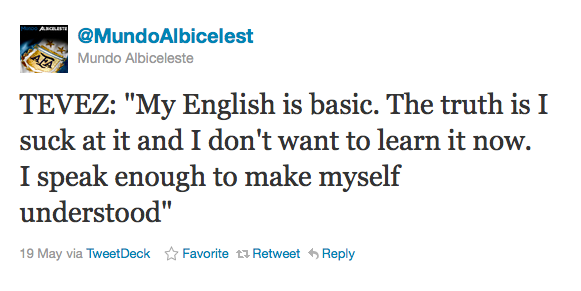
On May 19th @MundoAlbicelest tweeted the following:


I couldn’t help but imagine what Tevez has been like in the classroom. What kind of learning experiences has he experienced up to this point that made him feel this way? Was it is his fault, did he have a bad attitude, or did the teaching he receive not match his particular requirements?

My feeling is that (almost) everyone can be taught, no matter how difficult they seem, and it’s our responsibility as teachers to find the right style for our students. That’s not to say that it’s necessarily easy, of course.

So my question to you is: If he was in your classroom, how would you teach Carlos Tevez?


Read more ►

Thursday, 2 June 2011

From Morrissey to Marmite - Why You Need To Help Your Students Find Their Passion

2 comments
Morrissey, the British singer best known as the singer of the Smiths, is one of those decisive characters that is ever loved or hated in roughly equal measure. We have a phrase for that in British English, the Marmite effect, named after the particularly pungent yeast-based spread that seems to divide the public in two. This is something that Marmite themselves haven't been afraid to exploit, as you can see below:


Anyway, back to Morrissey. It seems that he's an extreme example of the Marmite effect, as the people who dislike him appear to loathe him. He has been accused of racism on more than one occasion, unfounded I think (I think he loves being a provocateur, sometimes with unfortunate consequences). At the other end of the spectrum, the people who love him take adulation to a whole other level that is difficult for the non-acolytes to comprehend.

I have first hand experience of this as in a previous, non-ELT life, I was a music buyer for a central London music store. One day I was told that he was downstairs having a browse in our DVD section. I immediately rushed to find my friend, one of the believers in the church of Morrissey, who, standing about 15 metres away from him, staring with bloodshot eyes and with the tears slowly forming, asked me "Should I go and speak to him?" Weighing up the facts at hand and the very likely prospect of Morrissey being slightly disturbed by the sight of my blubbing incoherent friend, I thought of that sage maxim that I live by to this day: "Never meet your heroes." It was probably for the best, I think.

At this point you are probably and justifiably wondering why I am banging on about a bequiffed indie singer on an ELT blog, but hang on in there, I'm getting to the point.

Morrissey

Recently I was talking to a friend, who speaks superb English as his second language and was an English teacher in his own previous life, about his own love of Morrissey and suddenly all this worship made sense. He described how as a gay teenager he pored over the lyrics of The Smiths' songs, finding meaning and understanding in poetry that seemed to be written for him and his life.

This led him into a distant love affair with not only the singer and writer of the song, but also the land of their origin and the language that they were written in. These brilliant lyrics, dripping with wit, beautiful wordplay and culture, were analysed and deciphered. My friend described how he was desperate to visit England, a country far from his own that was hardly portrayed in the most positive way:

"Trudging slowly over wet sandBack to the bench where your clothes were stolenThis is the coastal townThat they forgot to close downArmageddon - come Armageddon!Come, Armageddon! Come!Everyday is like SundayEveryday is silent and grey."

Lyrics from the Morrissey song Everyday Is Like Sunday.

He was also equally despairing to understand all of the lyrics that seemed to speak to him directly.

"I am human and I need to be lovedJust like everybody else does.
There's a club, if you'd like to goYou could meet someone who really loves youSo you go, and you stand on your ownAnd you leave on your ownAnd you go homeAnd you cryAnd you want to die "

Lyrics from The Smiths How Soon Is Now.

And as my friend said "it meant the world for a depressed, ill-loved 17 year-old". And as an aside, he also learned the meaning of some useful vocabulary (soil, climb, cling, bride, groom, loutish, and good-looking were all gleaned from just one song, I Know It's Over).


As teachers, we are unlikely to find that most students have this kind of love and passion towards the language we teach. However, this conversation reminded me that if we discover, whether by accident or design, that our students find some aspect of the culture and subsequently the language of interest to them, we have to pounce upon it and use this as a way of encouraging their continuing studies. If the greatest resource in our classroom is the student themselves, then to miss this opportunity would be more than unfortunate, for both the teacher and particularly for the student.

It is normal, maybe even human, for us to enter the classroom with our own pre-assigned set of tastes and values which we cannot help but be influenced by. I know I do this, because more often than not I end up directing learners towards the Guardian because I think it's a great newspaper. The positive side of this is that our students can interact with a teacher who is passionate and cares about a subject or source of material. It gives them the chance to become involved with an authentic element of the culture in an enriching way.

The flipside is that it is prescriptive, and an imposition of taste upon the learner. I'm wondering if I had a student who loved Celine Dion and, god forbid The Daily Mail (no links to them, you may notice), would I be able to set aside my prejudices and cash in on their passions, even though it would make my job less pleasant? I don't know, because as far as I know, it's never happened, and that's the problem, I never gave them the chance to tell me.

So these thoughts lead me to the conclusion that when I'm doing needs analysis with a new student(s), I need to give them the chance to tell me about their current and past relationship with English language culture, and any passions they may have. It is entirely possible that there is nothing that they care about strongly, but I at least have to give them the chance to tell me, so I can cast my own prejudices aside and make the learning experience as rich as I can for the student.

And if I was teaching my friend now, I would fill his classes with the poetry of Morrissey and the taste of Marmite, which is, appropriately enough, his other great British obsession.

Marmite
Read more ►
 

Copyright © TheTeacherJames Design by O Pregador | Blogger Theme by Blogger Template de luxo | Powered by Blogger