Monday, 17 October 2011

ELTchat Summary by Edith Occelli - How can you teach Business English with minimal experience of being in the business world?

2 comments
The following ELTChat summary was written by Edith Occelli, but as she doesn't have a blog of her own, I offered mine so she'd get the opportunity to share it with everyone. I'm sure you'll agree that she's done a fantastic job. You can follow Edith on Twitter at @EdithOccelli.


ELTchat - How can you teach Business English with minimal experience of being in the business world?

Last Wednesday's ELTchat 9pm discussion focused on the interesting (albeit controversial) topic of Business English and whether it is possible to teach BE classes having no business experience. The conversation was fast and furious and, as a newcomer, it really amazed me how much ground was covered in a single hour @_@ I just hope I can squeeze all the main points in this summary ;)

The discussion kicked off with chatters attempting to define Business English and what it constitutes. Definitions varied from the broad Communication skills for business contexts to more specific things like learning business terminology and working towards internationally recognized qualifications.

Then, after a brief "hands up" revealed that many participants had experience teaching BE classes, chatters jumped in to discuss one key question: Is business experience required to teach Business English?, a query that had no straight answer but for which everybody gave their opinions. 

Some said it "Yes, it is":

·       "advanced learners need expert in business to teach them English"

·       "Personally, when I'm the student I prefer when my teacher has personal experience in the field & learning from their anecdotes"

·     "We definitely need business skills. Some are acquired in coaching + through experience, but many we really do need to learn"

·        "I think advanced students (& co.s) are looking for more & more specialist training need ROI!"

·     "How about teaching things like negotiation, doing a SWAT analysis, or creating special docs? Doesn't teacher need that experience?"

·       "I believe that it is very difficult to truly be a BE language expert w/o direct experience of nuances of BE language :-D"

·        "If I want to learn BE I would trust a business expert rather than excellent ET"

·        "I think that those Ss who want both to stay ahead in the field will pay more for teachers with experience"


Whereas others said it was not really a requirement:

·       "I've never had that problem. They know you're not a business expert & don't expect it from you (thankfully!)"

·       "There's a common misunderstanding that bus sts need business classes. They don't, they need to improve their bus lang skills"

·       "I can see how it'd help but not necessarily"

·       "Much has been said abt business, but a lot of learners just want to be fluent"

·       "No but you need to understand concepts"

·       "No but they do expect u to be a language expert who knows how professionals communicate"

·       "I think it's going more & more towards specialist + elt but as the ELT expert in what might be a partnership it can work"

·       "I think is less about content and more about successful communication"


Still, some other thought it was first necessary to clarify what was being meant by having "business experience"?

·       "But what IS an expert in business? There are many different types of business experience as the Ss we're teaching, right?"

·      "Teachers ARE in business if they work 4 a private school - this exp can be milked too - esp'ly if u have admin responsibilities"

·       "I find it hard to believe that nobody has BE experience. If you've worked somewhere, you have experience to draw from"


And the conversation flowed all over the place with both sides passionately defending their views:

·       "Advanced Ls need expert in bus to teach them English  > really?  they want 2learn English not business!"

·    "Chances are that ss knows more abt their business than you. Your role is to help them express that knowledge in English"

·        "But you won't help them in using E if u r not an expert in bus especially advanced bus learners"


This went on for a few minutes until some people skilfully pointed out that:

·        "Different BE students can have very different needs and goals" 

·       "What do business learners need from English ?---> - a question must be asked before figuring out what to teach" 
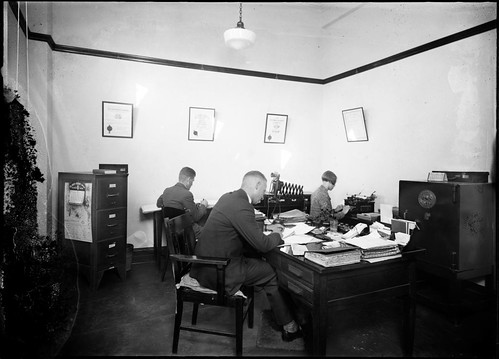
Working in an office (St Stephens)

So that all chatters were (at least partly) right since the need for experience depends on different factors (e.g. context, level, type of class, Ss goals, company requirements, etc).

From this, a new subtopic ensued with chatters discussing different BE contexts and learner expectations:

·       "I would seperate business english from general english for business people. BEng more specialized"

·       "I find most advanced bus stds know the tech language and flounder with gen/soc English"

·       "Some customers looking for a hybrid - a kind of business CLIL - then teacher obviously needs the relevant subject knowledge"

·       "The scenario is different if we have to teach them abt doing businees w/ other cultures - we may have more experience here. "

·     "At our institution, the Business studies teachers teach Business Communication so we can send Adv. Learners there"

·       "But when bus stds arrive in the UK to work what they need is vocab, idioms, social language mostly"

·       "I find it more of a coaching role - helping sts succeed in their career"

·       "Teaching business English has become a branch of business consulting"

·    "What we have found is that in 1-2-1 the focus is much sharper on BE - in grp classes sponsored by company they want other stuff too"


Once this variety had been established, the conclusions were:

1.     The majority of BE students want increased fluency and English for social situations.

2.     Business expertise is only a requirement for some types of (specialized) BE classes. However, it is always an advantage ;)

3.   Most ELT professionals, even those without "business experience", can adequately support BE students when forming a partnership with their learners.

Later, after taking this most interesting of detours, chatters set up to share their advise on the main topic of the evening which was: … (drumroll) How to teach BE with minimal experience of being in the business world. 

Here is a selection of the TOP TIPS:

1.     Get a good start:  find out everything you can about the learners' roles and their companies, fish for ideas, take a course in BE, etc.

·    "if you've never been in Business but find urself teaching BE - do a thorough needs analysis and Profession analysis"

·       "Company documents extremely useful - for bigger clients we also send sb to spend a day in company "

·   "I did the IH Business English Teaching (BET) certificate. Useful, and avail to non-IH teachers too http://t.co/PiCrRuVw "

2.     Stay informed: take an interest in business and current affairs, read widely, join groups, etc.

·       "Reading articles to stay up-to-date, watching business channels on tv, listening to podcasts and news"

·    "I think joining in some LinkedIn groups also helps to observe the communication. A lot of business is communication"

·       "Definitely the #besig hashtag, webinars, and website are full of great information http://t.co/29mdITil"

3.     Use your learners' expertise: ask them to explain, to give you examples, etc learn from them!

·       "Ask your students to provide as many real examples of the English they need to deal with emails, reports, brochures, calls"

·       "Get the students to show you around - ask intelligent questions - ask Ss to bring in documents they have to handle in English"

·       "A good idea to get them to teach you the processes while you feed in the language"


4.     Draw on your experience: whatever jobs you've had identify similarities, transferable skills, etc and use them.

·       "That's what I did - I used my experience as a 'worker' when teaching to the managers!"

·       "True If you can teach "How much?" in a supermarket context for GE teaching Negotiation for BE is much the same"

·       "I worked in supermarkets, shops and offices before becoming a teacher. It was very informative when I started teaching "


5.     Be humble: know yourself, recognize gaps in your knowledge and be willing to learn.

·       "Teachers shouldn't pretend to know more than they do about business"

·      "we need to know our strengths (& weaknesses), listen carefully and intelligently, spot the areas where Ss need support"

·       "whenever I taught I found myself learning lots to help my learners -  I even learnt binary math!"


Old Style Cash Register and Canned Goods in a Butcher Shop in New Ulm, Minnesota ..., 10/1974


 Chatters also agreed essential points for all BE teachers (and GE for that matter) this were:

1.      Having "face validity" (smart looks)
2.     Providing authentic practice for Ss
3.     Conducting a thorough needs analysis
4.     Tailor classes to fit in with Ss lives (E.g. mp3, online learning, etc)
5.     Promoting inter-cultural awareness


Some common problems like mismatches between learners Vs company wishes, compulsory coursebooks, and working with lower language levels were also briefly touched upon:

·       "We generally tell company shd be a balance of BE and Non BE stuff otherwise lose the Ss - in there but out to lunch in their heads"

·       "books I've used seem very vocab heavy, with little practice of it. Books were company requirement. 2 units = 1year"

·       "S/s I taught, their language was not on the level to do business expert type stuff w/ they really needed basics…"


Finally, participants suggested some wonderful Business English activities:

·     "Take me on a tour. My students loved doing that when they learned the right language. Useful for some"

·     "Take all of the numbers from a reading text & use them to describe trends / patterns etc (from Teaching Unplugged)"

·    "Crisis real time role plays. Feed information to groups which they deal with in real time. Each has an assigned role"

·       "With Skype classes you can have sts prepare, call a headhunter and practise real conversation"

·       "How about writing to an ISP re. spam or phishing email that came to their account?"

·       "Get them blogging. They can practice writing various business writing"

·       "Design a Facebook Page or website for their company? "

·       "Designing dream teams with famous business people, balloon debates etc"

·       "I use industry relevant docs, video, pdf them, and then annotate in a virtual class, record it - with courses"

·       "can give students exposure to experts through podcasts etc"

·      "Do a TED search on their subject area of expertise - try to find good short videos 3-6-9mins for authentic listening"

·       "How about case studies for business courses.. do any of you adapt some for BE purposes?? I think they made do good classroom activity "

·        "try to hooks stds up with s'one their field with whom they can discuss the role in English"

·        "Get them to do pecha kuchas if a class - or their presentations if involved in presenting"


Overall, I think it was a very productive session and I'd like to thank everyone for your great contributions.  Special thanks go to Shaun, Shelly, and Marisa for their skilled moderation and for giving me the opportunity to participate and write this summary. I'd also like to thank Berni for her endless inspiration and encouragement, and of course, James who kindly let me post this on his blog =).

Wish you all a great week!

Links to resources shared:


Thanks again Edith for your wonderful summary. If you’d like to do an ELTChat summary of your own, and you don’t have a blog to post it to, don’t hesitate to ask and I’ll host it for you.

Read more ►

Monday, 3 October 2011

Blog Challenge: Compare and Contrast Photos

3 comments
I previously mentioned in my Free iPad Apps for the ELT Classroom post that I used these photos in a recent class, and Brad Patterson's compare and contrast photo blog challenge gives me the opportunity to go into a little bit more depth about how I used them.

Taken from the Guardian eyewitness iPad app

Taken from the Life magazine iPad app

It was the day after the riots in London escalated and became international news. My student (in a one to one class) is an anglophile, having lived in London for a year, so there were was only one topic of conversation in that lesson. She's an intelligent person who is prepared to speak about almost any subject and can really engage with meaty subjects.

The conversation turned from what happened to how and why it happened. In my opinion, these are complex social matters that cannot be discussed glibly and I was delighted that we were able to have such a high level conversation. I made the point that I think there are some serious problems within British society that will take generations to solve, if the population is willing.

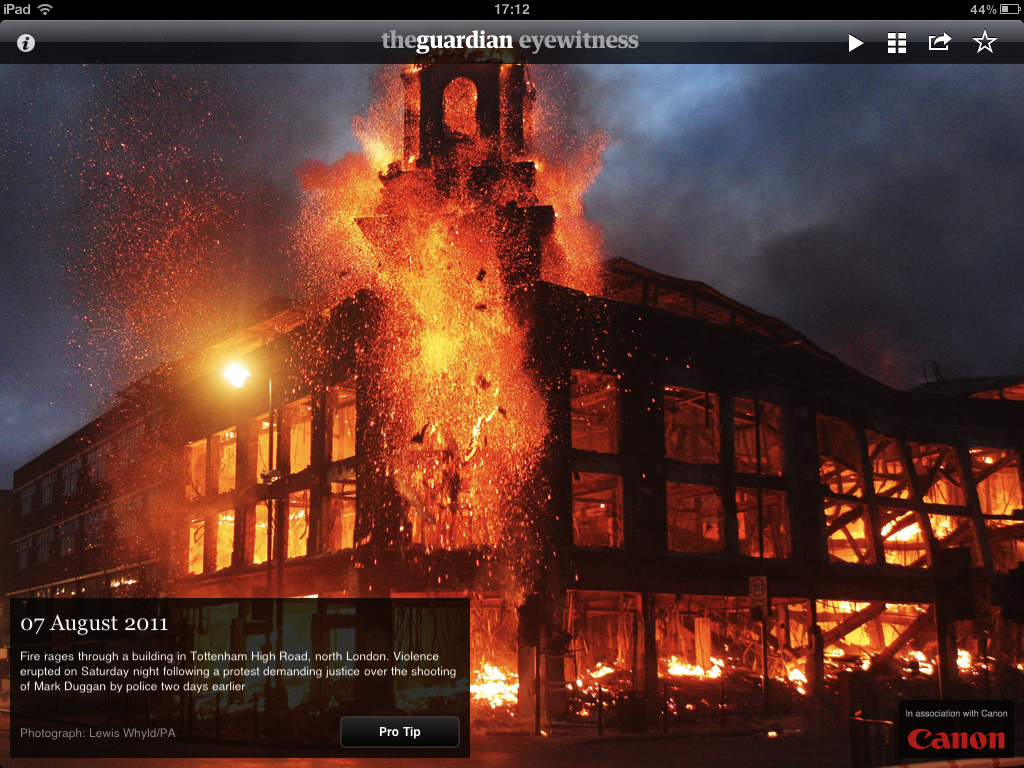
Where the photos came in was that I was quickly and vividly able to illustrate my point. The first photo was taken during the riots, a stunning image that captures the intensity of what happened. The second was taken in 1940 as London came under attack during the Second World War. The point I wanted to make with these similar images was that a huge project of rebuilding was undertaken with political consensus after the war, so there is no reason that it couldn't be done again. I think that by using these similar images I was able to reinforce my point without needing to resort to rhetoric or time consuming online research.

The lessons I learned from this were:
  •  images can be compared to emphasise arguments, which could be the grounds for an interesting activity in the future.
  • we don't always have to think of these resources as the seed of an activity. We can just as easily use them during our natural conversation with the student in all manner of ways (to illustrate, to explain and to refute for example).
  • never underestimate the students ability to engage in high order thinking. Their difficulty may be in the ability to express those thoughts, but that doesn't mean they won't surprise you if you give them the opportunity. It also displays how much you respect them as an individual, not just as a student.
  • don't be afraid of expressing your own opinions. Obviously you have to be able to read the situation and react sensitively, but in general my students are paying to have lessons with me and if I can, I will be myself. Conflict isn't good, but conversation and the sharing of ideas is always healthy.
You can read plenty more posts in this blog challenge. Go to Brad's original post for links (here).


Read more ►

Saturday, 1 October 2011

A Weekend in Zug

4 comments

Beautiful Zug

On September 17th I was fortunate enough to attend the English Teachers Association of Switzerland Special Interest Groups Day in gorgeous Zug, just a short train journey from Zurich. Among the many fascinating attendees were Mike Harrison, Ania Musielak and local resident Vicky Loras. As a way of reflecting on our weekend at the conference, we asked each other two questions to answer on our blogs. You can read Mike's answers here, Vicky's here, and my and Ania’s below.

First up, my answers...

Mike’s questions

Did anything surprise you about the conference? What and why/why not?

There were no surprises for me, but since they are not always a good thing, I was pleased about that. I expected a well run, enjoyable conference with great presenters and that’s what I got. The venue was perfect (apart from the lack of wifi!) and the whole event was very well put together.

Tell us one interesting thing you learnt about teaching.

Only one? I really enjoyed Anthony Gaughan’s demonstration of a simple and effective dogme class. There are a lot of misunderstandings and misrepresentations of what dogme is and how it works, so it was great to see such an excellent example in action. Anthony is an excellent presenter and I would encourage anyone who gets the chance to go and see him.

Despite appearances, Anthony's talk was well attended!
Vicky’s questions

Who did you meet for the first time there?

This was only my third ELT conference, and my second with a PLN, so it was a chance to catch up with some friends I’d met at IATEFL (Ania, Vladka Michalkova) and spend time with people I’d only met briefly (Mike, Ken Wilson, Mike Hogan). It was also great to meet some people for the first time. Vicky is well known to everyone on Twitter and the PLN for her energy and enthusiasm, so it was fantastic to find out she’s just like that in real life! Chuck Sandy’s appearance was also a pleasant surprise as I didn’t know he was going to be there until I saw his Facebook status update that morning. I look forward to seeing him in Paris in November.

What did you like the most about Zug?

It wasn’t the weather! From what I saw of it, Zug is a lovely small town. I just wished I could have stayed there longer, and that the weather had been kinder on the Sunday morning when I had some free time. I’ll have to make up for it next year.

Ania and Vicky enjoying Zug's nightlife

Ania’s questions


Which idea taken from the conference have you already used with your students (or are planning to use)?

It’s tough to choose just one. I’ve been very influenced by Ken’s suggestion that we need to choose more thought provoking and engaging materials for our students to read (see this blog post to learn more). I also really liked some of your (Ania’s) practical suggestions for positive feedback and reinforcement. Using the coloured blocks as a way for the students to subtly express how they’re feeling about the activity is a great idea, and the demonstration of sandwich feedback was very effective. And Mike Hogan showed us that we can use business with beginners, which is something I'll be looking at more closely.

Did you have enough time for networking and meeting friends?

There’s never enough time, is there? But since we got to meet up from Friday night to Sunday morning, I can’t complain! I find that the opportunities to meet up with everyone, which have been facilitated first by Twitter, then by blogs and Facebook, mean that the social aspect of a conference is just as important as the presentations. It all adds to a really rewarding weekend. 

Now it’s Ania’s turn...

Mike’s questions
Did anything surprise you about the conference? What and why/why not?
I was surprised by how friendly and open everybody was. And not at all afraid or shy to participate in the workshops (well, some needed a push, like a bag of candy as a reward, yes James, I’m talking about you ;) ). I also felt very comfortable when it comes to finding my way around the venue – IATEFL Brighton was a huge event and I often got lost!
Tell us one interesting thing you learnt about teaching.
I would have to say that Ken Wilson’s workshop on drama gave me a lot of new ideas.  As I use drama in my classes, I always look for some activities, especially for elementary students, that can help them open up. And Ken proved again that even the most basic conversations (like “What time is it?”) can be delivered with flare and passion. He made us use two (very old) mobile phones and have this exchange in an angry mood, which we later switched to a calm one.

Ania in action.
James’ questions
Apart from giving your own presentations, why did you want to go to the conference?
I love attending conferences as they provide me with so many ideas that I can use in my classes. Observing other teachers motivates me to be a better educator. Conferences are also a wonderful opportunity to talk to friends and share our thoughts about teaching (well, not only teaching ;) ). But I guess I would have never come if it hadn’t been for Vicky and her encouragement and huge help.
Apart from your own presentations , who were you most looking forward to seeing present?
As Vicky Loras, Mike Harrison and Vladka Michalkova were presenting at the same time as me, I couldn’t attend their sessions. But I was really looking forward to seeing Ken’s plenary and his drama workshop (which was amazing, but that is not surprising as he’s the Drama King ;) ). I was also very happy that I managed to attend Anthony Gaughan’s session on recycling vocabulary which showed how to use the language that occurs on the lessons.
Vicky’s questions
Who did you meet for the first time there?
Oh, so many people…But I loved meeting Chuck Sandy and Andreas Grundtvig face to face.
What did you like the most about Zug?
It’s such a wonderful city, I love the lake, the open-air restaurants and the castle in the Old Town. I also liked the chocolate and delicious cakes served in cafes – the apfelstrudel was yummy. Next time I’m going to try the Kirschntorte which is strongly spiked.

Ania, James, Mike and some swans. 

Read more ►

Wednesday, 21 September 2011

Free iPad Apps for the ELT Classroom

14 comments


One of the great things about having an iPad in the classroom is the quick and immediate access it gives you to relevant and authentic content. It’s the perfect tool for a materials light, one to one teacher like me because something interesting can crop up in conversation and I can almost instantaneously bring up a great resource to share with the student.

Recently, a student told me that she was tired of all the lies in the media and I jumped on YouTube and showed her a clip of Bill Hicks talking about “the truth” (she’s the kind of student who’s not offended by Bill Hicks!) Another time she told me that her favourite place in London was Waterloo Bridge, and one minute later she’s listening to Waterloo Sunset by The Kinks.

So it goes without saying that YouTube is an essential app, but since I’ve had my iPad for a couple of months now, I thought I’d compile some of the apps that I’ve found most useful in the classroom, or see potential in although I haven’t had the opportunity to use them so far.

Images

Here I go, banging on about the Guardian again, but their Eyewitness is a beautiful and simple app that have used several times. It’s a ‘picture of the day’ app, so every 24 hours there’s a new sumptuous image that could be used in a variety of ways. The photograph below was very useful after the London riots, especially used in tandem with the next app.


The app from Life Magazine has collections from their extensive photography vaults. It begins with a handy map of the world, so you can check for pictures for the area your students are interested in. You can also search by theme. I used the collection of London during the war photographs to contrast with the riot photo from the Guardian app.

For more images, you could also try the Heritage app for pictures from UNESCO world heritage sites.

News


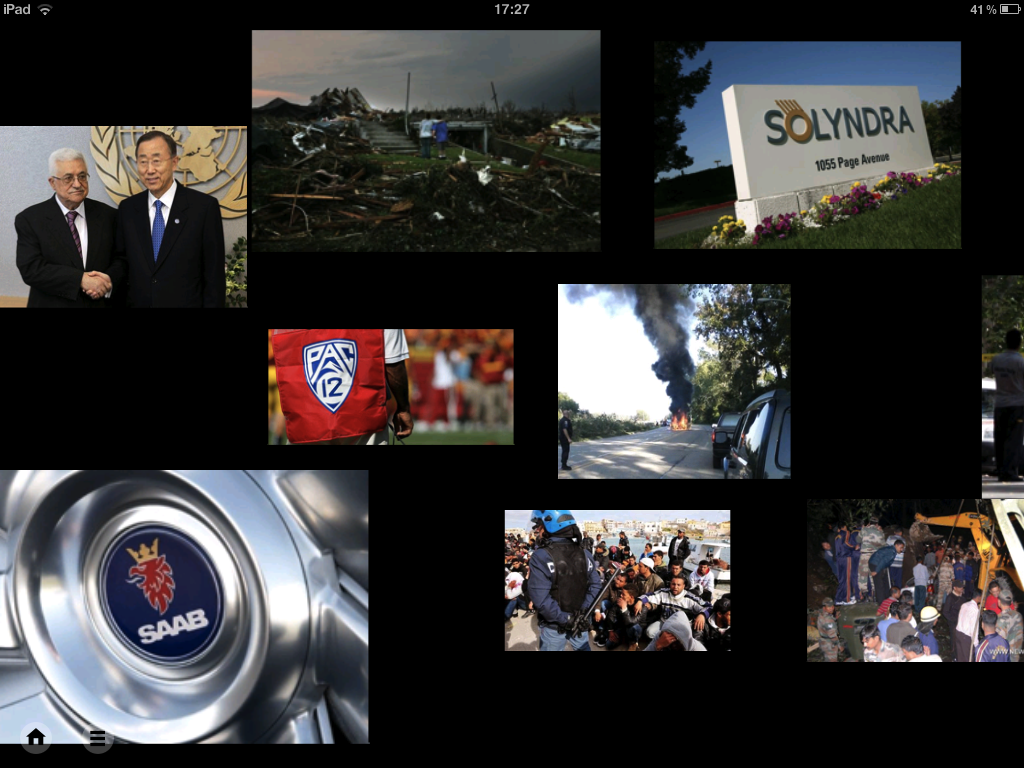
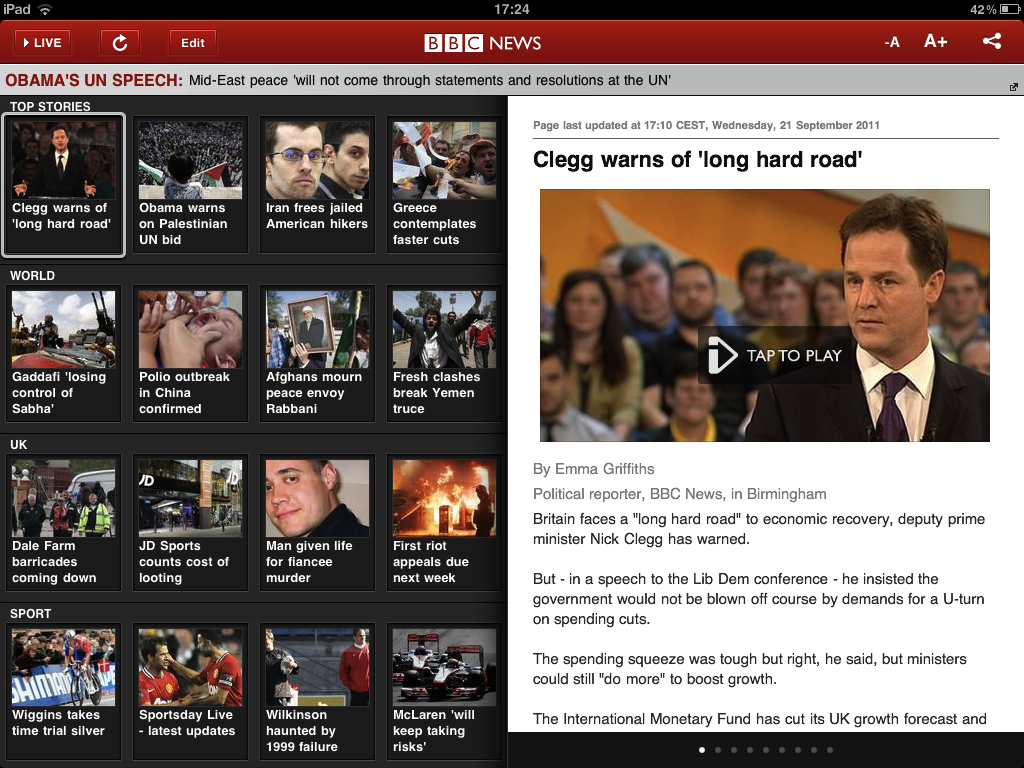
For news, there are plenty of interesting apps that give you quick and easy access to what is going on the world. BBC News is clear and easy to use, as is the Channel 4 news app. I also like the News360 app because you scroll through news stories by picture alone, and could get the students to choose a story based on nothing other than the image. Newsy is also a good source for up to date content.


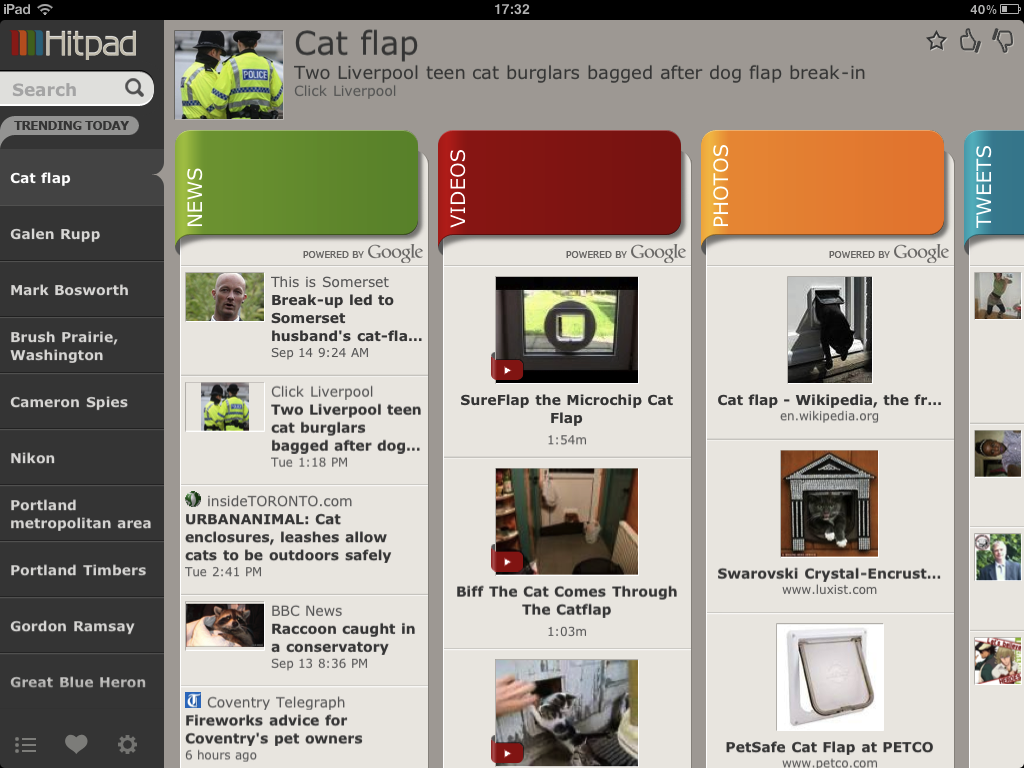
Hitpad is another interesting way to access what’s going on in the world. It presents the news in a series of streams (news stories, videos, tweets, photos and web). It’s a great resource for getting information on a topic from a variety of sources.


Video

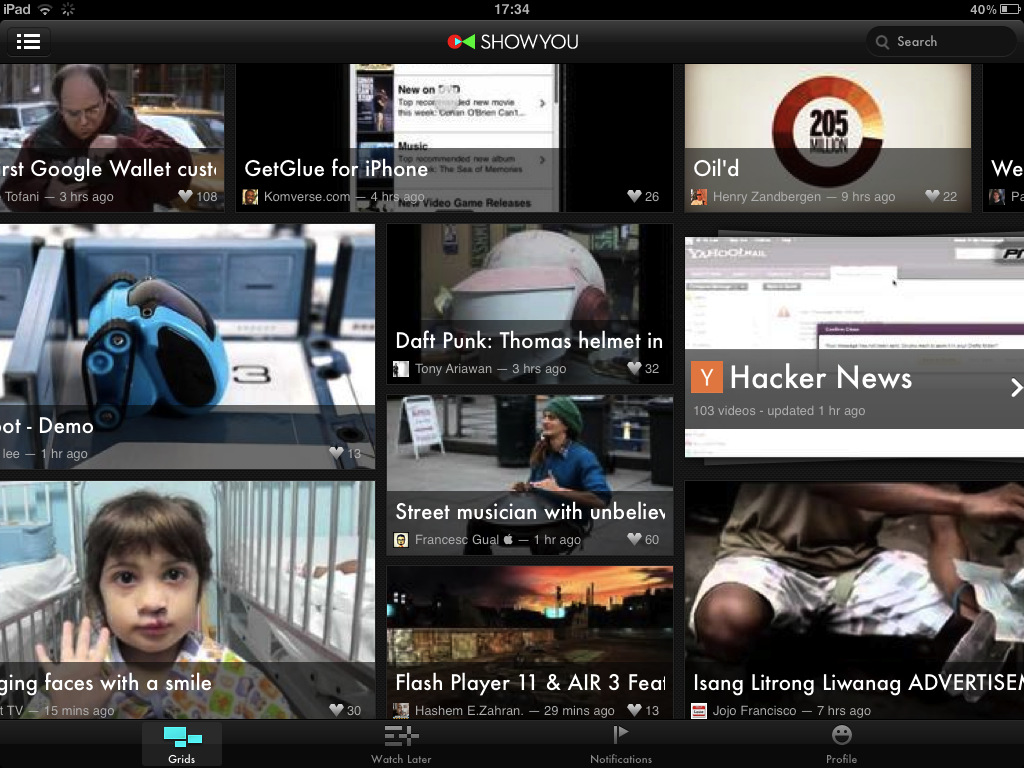
ShowYou aggregates a variety of different and unusual videos from a range of sources (which you can preset, if you wish). It has an almost unlimited potential to give you something interesting to use with your students. Square Eyes is a similar app.


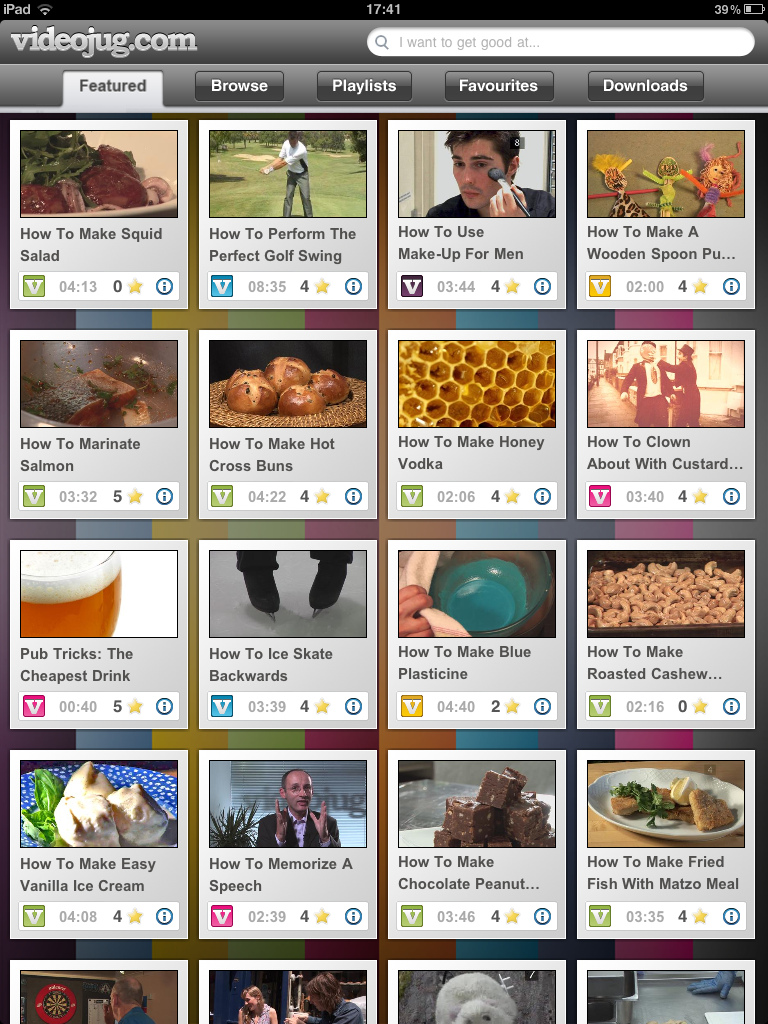
Videojug specialises in ‘how-to’ videos, so if you’re looking to use an instructional videos, they have a huge selection to choose from.


And of course there is TED, which has two apps, the normal TED app and, especially for learners, a fantastic app with subtitles. The script scrolls at the bottom of the screen, and can be used to control the video. So if the learner wants to go back because they didn’t understand a particular phrase, they just touch that line in the script and the video will jump there. I think it’s pretty obvious how useful that could be.


Business

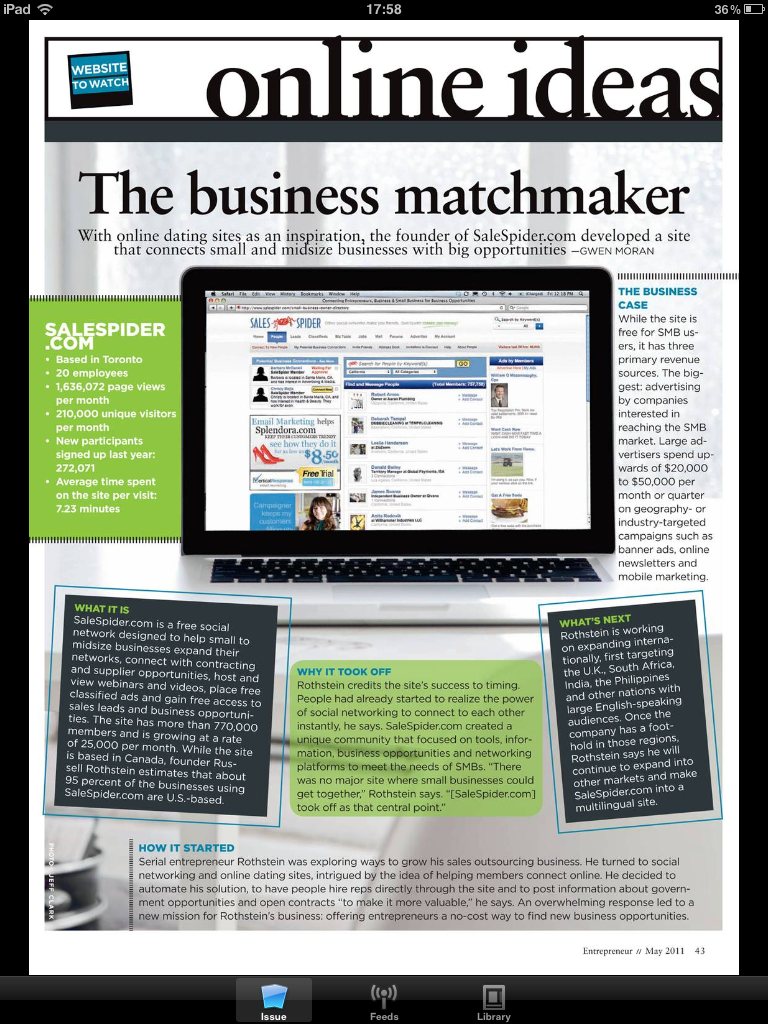
For business students, you can download copies of the Economist’s Intelligent Life magazine and Entrepreneur magazine for authentic and interesting materials.


Books

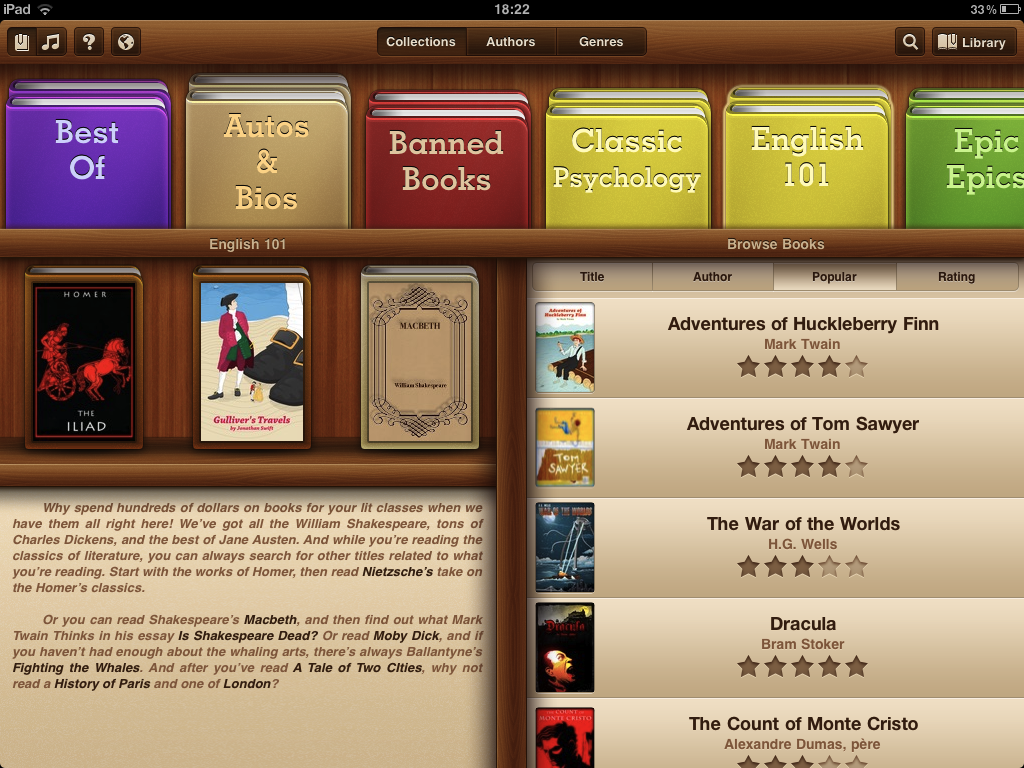
If you’re lucky enough to use literature with your students, there are thousands of free books available. However most of them are out of copyright, and being over 80 years, they may present a challenge even for advanced learners. My favourite books app, apart from the native iBooks app, is the aptly named Free Books, which is browsable by topic area, such as epic epics, banned books, ghost stories, pulp and young readers.


Other great book apps include Shakespeare, Poetry (a random poem generator), Stanza, and the British Library’s beautifully presented 19th Century Books app.


Teacher Tools


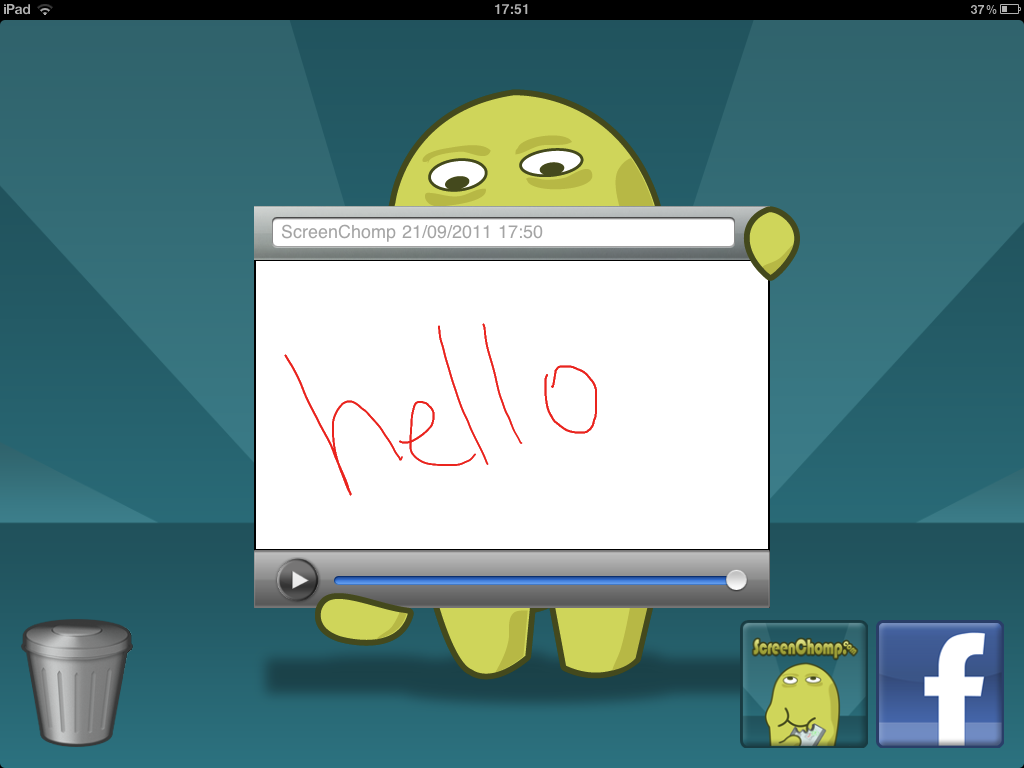
From a more obvious educational standpoint, there are some lovely whiteboards apps such as Screenchomp, where you can record what you write or draw and send it to the students, and ShowMe, which is very similar. I’m also very curious about SpeedGrader, which seems to allow you manage your classes homework, amongst several other things, but since I’m teaching one to ones at the moment, I haven’t really explored.


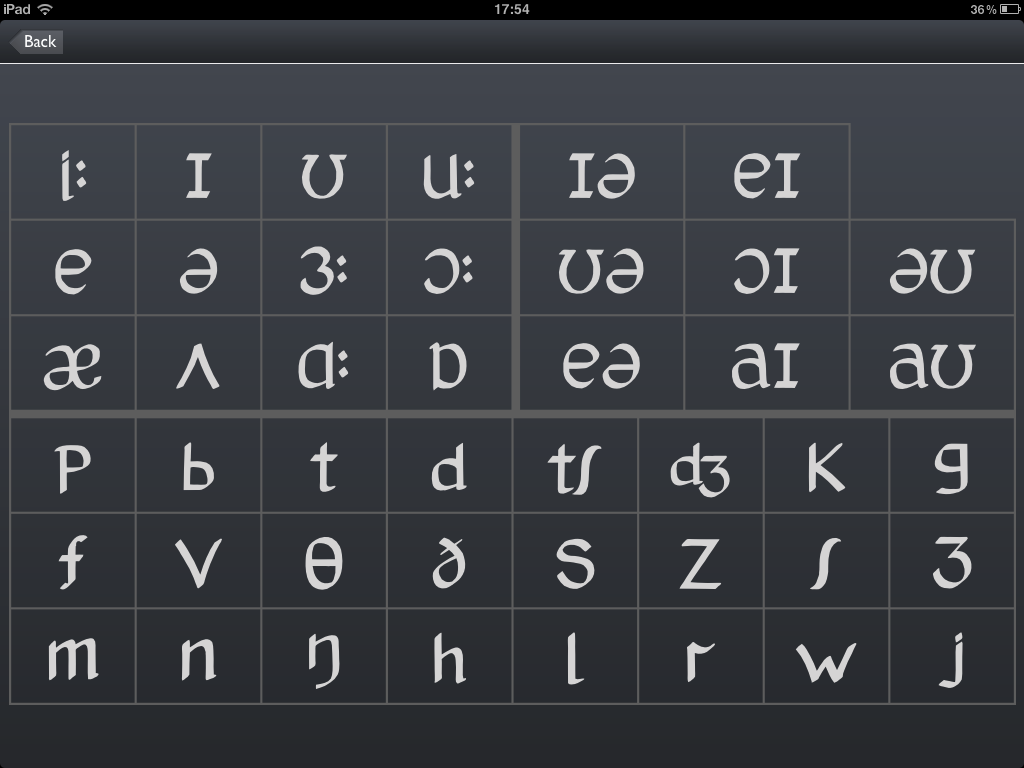
Finally, I’m not a fan of using the phonetic chart in my classes, but if you are, then you really need to download Macmillan’s gorgeous app. Not only do you have the chart in your hand, but you have the sounds too, in either British or American English.


I’m always looking for new apps, so if you have any that you’d like to recommend, leave a comment below. Thanks.

Read more ►

Friday, 9 September 2011

Getting to know you activity: personality test

10 comments
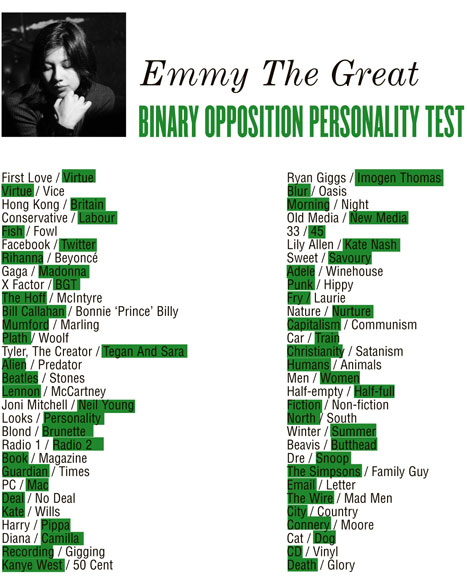
At this time of year, it seems appropriate to share a ‘getting to know you’ activity. I came across this quickfire interview (for want of a better word) with the singer Emmy the Great in the (occasionally NSFW) music magazine The Stool Pigeon:


I thought it would make an interesting way to introduce yourself and the students to each other at the beginning of a new class. Obviously, you need to make your own (I dream of having a class where I can discuss the relative merits of Bonnie ‘Prince’ Billy vs Bill Callahan!), but I think it’s easily adaptable for any type of class.

Here’s how I’d use it in my classes:

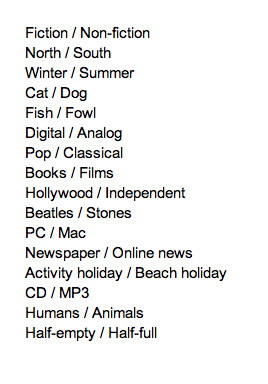
1) Give the students the following on a handout:


2) Explain that this list is a way for them to find out more information about each others personalities. Write the first line on the board. Explain that on each line there are two choices which could be considered opposites, using the line on the board as an example.

3) Explain that you want to make sure they understand all the choices before they make a decision. Ask them to read them to read the options and discuss any problem vocabulary with a partner. Do a CCQ to make sure they understand exactly what you want them to do, especially since you don’t want them to take the test yet.

4) Get feedback and discuss any new vocabulary as a class. Make sure that you don’t give anything away about your own personality at this point.

5) Now ask them to individually take the personality test, highlighting or underlining the choice they think best reflects their personality.

6) Once they tests are complete, ask them to compare their answers with their partners and discuss their similarities and differences.

7) As a class, get some feedback from the pairs. Ask them to share some of the similarities and differences they found.
8) Ask everyone to stand up. Tell them that you are going to divide the class into two groups, so we can find out more about each other. Choose one of the lines from the test and divide the class into two groups by the preference. For example, you could ask the ‘cat people’ to stand on the left and the ‘dog people’ on the right. Put them into smaller groups if there are too many people on one side, and ask them to discuss why they chose cats over dogs or vice versa.

9) Do this three or four times with different lines from the test.

10) To sum up, ask the class if there was anyone who was in the same group every time, or 3 times.

11) Now ask them students in small groups to create four or five (depending on the size of your class) personality quiz choices to find out more about you. Once they’ve finished, depending on time and the size of your class, go round the class and answer the personality test questions they’ve written for you.


Note: There’s a danger that this part could become too teacher centred (“Now it’s your chance to learn alllllll about me...”), but I think this can be avoided by not spending too much time on it and by doing the activity after they’ve had the chance to speak to each other first. You’ve already shown them that they are the priority. It’s also worth remembering that the students really do want to learn about you, so I think in this early class you can be a bit more egocentric than usual.

Read more ►
 

Copyright © TheTeacherJames Design by O Pregador | Blogger Theme by Blogger Template de luxo | Powered by Blogger